etween winter air and warm lights: a journey through the St. Alban quarter, featuring solo harp music in three cozy, intimate locations. The Renaissance was a period of remarkable developments for the harp family: the instruments became larger, their sound evolved—among other things through the increased use of buzzing hooks – and early attempts were made to develop a fully chromatic harp.
The “Harp Parcours” leads to three performers and thereby three sound worlds of the Renaissance harp:
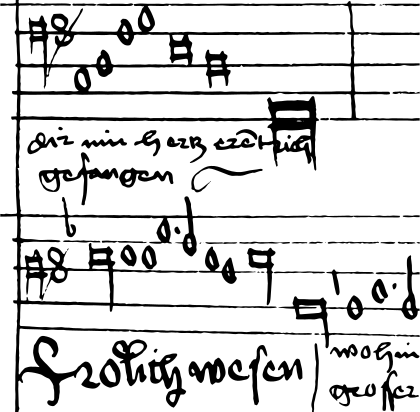
Claire Piganiol – The Gothic bray harp, with repertoire from the Welsh Ap Huw manuscript, one of the very few sources that transmits playing techniques and repertoire specifically for the late medieval harp.
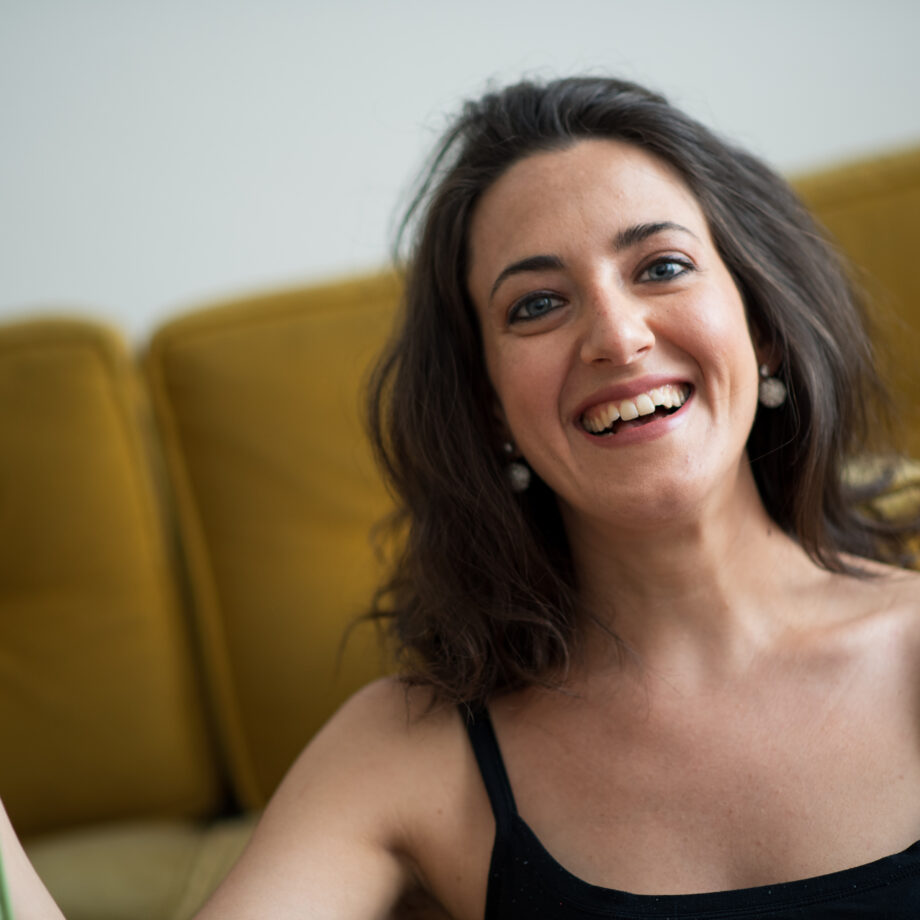
Carolin Margraf – The early arpa doppia, the two-row chromatic harp, featuring instrumental music and diminutions from a Polish source dating to the mid-16th century
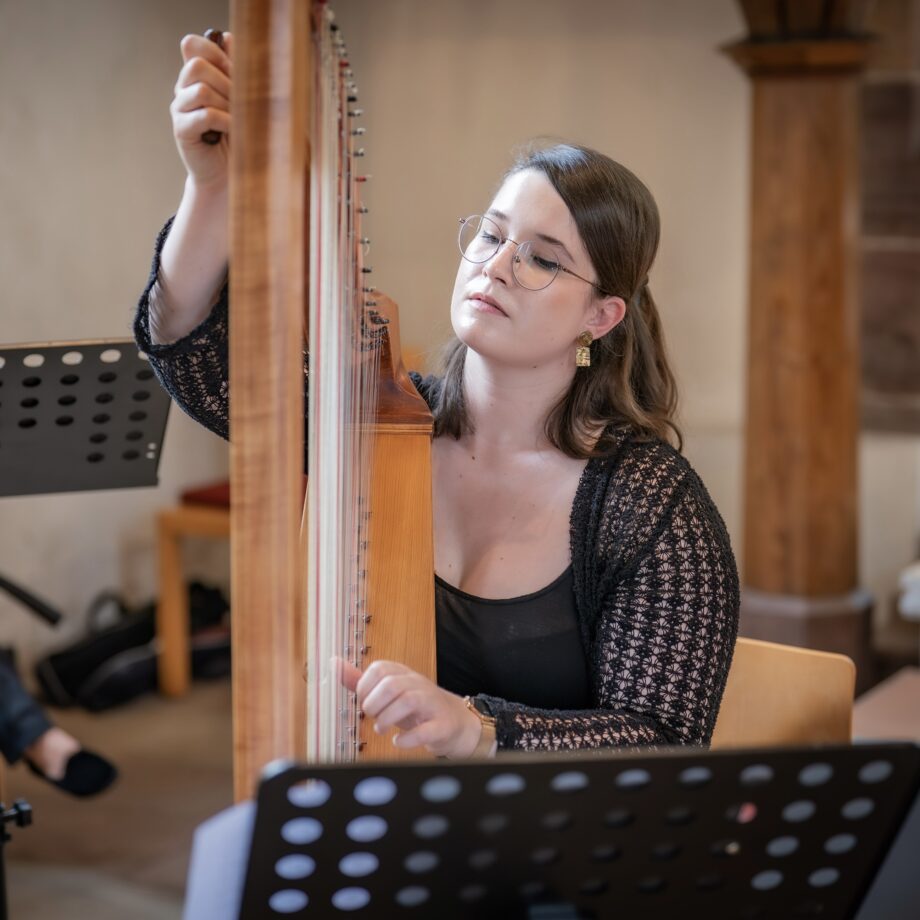
Flora Papadopoulos – The arpa doppia a tre ordini, with courtly music from the Kingdom of Naples around 1600
Please choose any starting point for your parcours route and arrive by 18:00.
– St. Alban’s Church, St. Alban-Kirchrain 11
– Event Room of the Basel Paper Mill, St. Alban-Tal 37 (3rd floor)
– Sternensaal, Gasthof zum Goldenen Sternen, St. Alban-Rheinweg 70
Free admission – collection
Option: From 20:00 you can reserve a 3-course menu (CHF 65) at the Gasthof zum Goldenen Sternen – the perfect way to round out the evening! Book directly through the restaurant: https://www.sternen-basel.ch/ | Tel. 061 272 16 66 | info@sternen-basel.ch
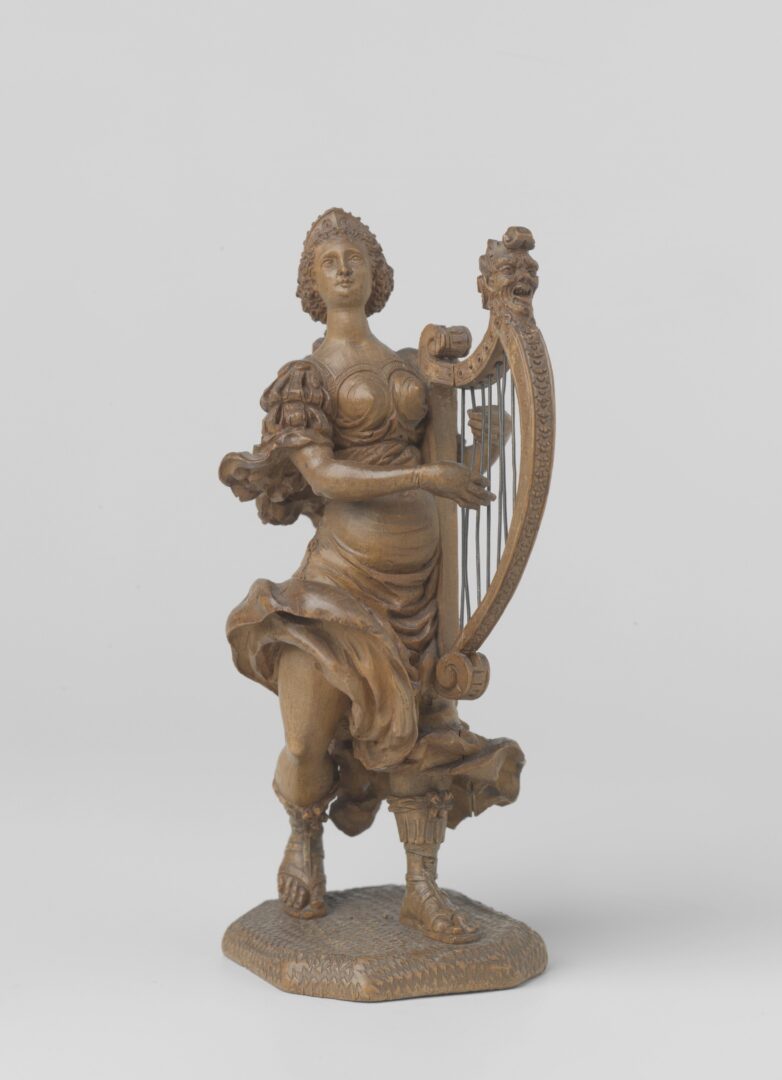
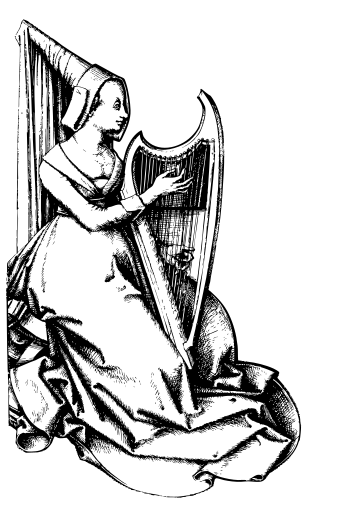
Terpsichore, süddeutsch, 1575, 13,5 cm © Rijksmuseum
März 2025
Was ist ein Lautenparcours?
TC: Dear Mrs Frau Papadopoulos, You began studying the classical harp at a young age in Athens and later encountered historical harps in Italy. What ultimately led you into the world of early music?
FP: Actually, I discovered early music in Paris. After completing my modern harp studies in Italy, I moved there to pursue a Master’s degree in Musicology at the Sorbonne. Until then, harp and musicology had followed two parallel paths in my life, and early music suddenly brought them together, allowing me to combine performance with research.
At the time there was no historical harp class in Paris, so I joined the lute class at the CNR on Rue de Rome. Studying as a harpist in a lute class was an unusual but enriching experience, based largely on listening and personal research. After two years, I realized I wanted to pursue this path seriously and needed a dedicated harp teacher, which led me to move to Milan to study with Mara Galassi at the Scuola Civica.
TC: Seeing ancient harps from cultures such as Egypt, one gets the sense that every culture developed its own harp. Could you give us a brief – and necessarily incomplete – overview of the history of the European harp?
FP: This is indeed a difficult question, because any history can be told from many different perspectives. I personally see the history of the European harp as a continuous transformation of the instrument in order to keep pace with the musical language of its time, and the central issue has always been chromaticism.
The basic idea of stretching free strings on a frame and plucking them with the fingers is very ancient, but the number of strings on a harp has always changed according to how many notes were needed to perform the music of the current time.
Single-row harps, like the ones you will hear in the concert played by my colleague Claire Piganiol, coped with their repertoire for many centuries through devices such as specific “scordaturas” (specific ways to arrange the tuning of strings).
Around the turn of the 16th and 17th centuries in Italy, the “cultivated” harp evolved toward instruments with multiple rows of strings in order to accommodate chromatic notes—roughly speaking, the “black keys” of a keyboard. The program I explore in my concert on February 22 focuses precisely on this moment of invention and flourishing of a very modern instrument: the “arpa doppia”, which was soon exported beyond Italy.
Single-row harps, however, never disappeared and continued to evolve as well. Manual shortening devices, known as hooks, were added to the strings to raise the pitch by a semitone. These harps, especially widespread in the 18th century, were common in popular music and eventually also entered art music in German-speaking countries. The decisive breakthrough, however, came with the invention of pedals—a system that shortens the strings via foot-operated mechanisms.
Throughout the 18th century, Europe saw a rich coexistence of many different harp models, each with its specific sound and aesthetic features, attempting to solve the challenge of chromaticism in its own way, according to the context and repertoire needs.
From the end of the century onward, however, the harp clearly followed one path in art music: a single row of strings combined with a pedal system.
TC: Was the harp in early music primarily an accompanying instrument for singing, and did it only become a solo instrument in the Classical period?
FP: Every musician could sing, as musical education for children was mostly shaped through choir training. The harp was the perfect companion for singing, and some of the most famous Italian virtuosi at the end of the 16th century were female singers who accompanied themselves on the harp, such as the “cantatrici” Laura Peperara and Adriana Basile.
But the harp didn’t become a solo instrument only in the Classical period—this happened much earlier.
Our earliest source of harp instrumental music dates from around 1540 (Leipzig I.191). Ascanio Mayone, the focus of my upcoming concert, was a harpist, organist, and chapel master. The Neapolitan school around Mayone and Trabaci created solo pieces for the arpa doppia—Toccatas, Ricercare, Partite—the same kind of repertoire an organist would play. In 18th-century England, John Parry was a famous harp virtuoso who left a large body of solo music. These are just a few examples—there’s a solo harp repertoire throughout the Baroque period.
TC: You also work with music from other periods and with so-called crossover projects. What role does the harp play today outside the early music scene?
FP: Today, many festivals and promoters encourage “crossover” projects, mixing early music with other styles to attract new audiences. I think about this a lot—both for our own careers and for the next generation entering this wonderful but fragile profession. For me, every project has to be interesting and carefully thought out; we shouldn’t sacrifice intellectual rigor just to simplify. Early music is defined by curiosity, discovery, and research, and these qualities can guide projects beyond the traditional repertoire without losing quality.
For example, I’ve worked for years with Laboratorio 600, with Franco Pavan and Pino de Vittorio. Pino has been a pioneer in researching and revitalizing Southern Italian folk songs, and for many years was part of the Nuova Compagnia di Canto Popolare. Franco’s research focuses on musical notebooks, mainly from 18th- and 19th-century travelers, who documented pieces of popular music and adapted them into written, “art” forms. Together, we create imaginative projects grounded in research, always communicating transparently so audiences understand these are inspired interpretations, not historical documents.
TC: Finally, looking at today’s musical landscape: Baroque music enjoys great media success, while the rich repertoire of Renaissance music often remains a niche. Are we only at the beginning of a process of rediscovery?
FP: I truly hope so, with all my heart! As far as the harp is concerned, there is still so much research to be done on the complex and varied world of Renaissance harps. I believe we are really only at the very beginning of this exploration.
I’ll be there
by David Fallows
Back in the late 1970s when colleagues and I were preparing for what became the complete recording of the Chansonnier Cordiforme of Jean de Montchenu (c1475), one great excitement was the publication of the collection of pictures of music-making in the fifteenth century assembled by Edmund Bowles in the series Musikgeschichte in Bildern. And I can still remember Tony Rooley telephoning me in 1977 to say that the book had arrived and that it had two seriously unexpected surprises. First, lots of trumpets; and second, lots of harps. In those days the harp was absolutely not part of the normal early music ensemble, but we drew the right conclusion and recruited a recently graduated harpist, Frances Kelly. What Frances told us was that the seriously interesting thing about harps in the fifteenth century was the use of brays to give body to the sound…
So we let her use brays, but only for one piece (because the whole idea was entirely foreign to us). Fifty years later, the world has changed. Everybody knows about brays and a thousand other things that contributed to making the harp one of the central instruments in the early music movement. All the same, the three mini-recitals with different harps in February’s ReRenaissance concert will be a rare treat, all in lovely venues on the Rhine in the St-Alban-Quartier.
Kirche Reigoldswil &
Barfüsserkirche Basel
Martinskirche
Basel
Barfüsserkirche
Historisches Museum Basel
Dorfkirche Riehen