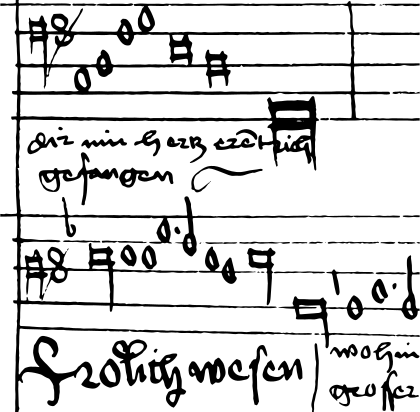
In no fewer than five songs by Antoine Busnois (c1435–1492), a complete name appears – either hinted at or spelled out as an acrostic: Jaqueline d’Haqueville. Although she cannot be identified with certainty, this woman was clearly the inspiration for Busnois to compose songs of striking originality and extraordinary expressive power.
Korneel Van Neste – voice
Dina Picon – voice
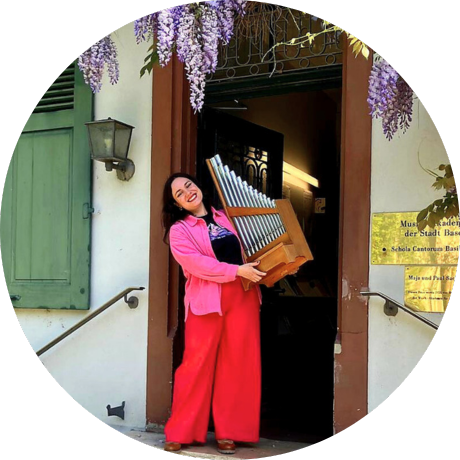
Ivana Ivanović – voice, portative organ
Elizabeth Rumsey – viola d’arco, rebec
Marc Lewon – lute, viola d’arco, rubecone; direction
Saturday, 27 June 2026
6:15 pm Concert
Nydeggkirche, Nydegghof 2, 3011 Bern
Sunday, 28 June 2026
5:45 pm Introduction (Clemens Goldberg, Berlin)
6:15 pm Concert
Barfüsserkirche, Historical Museum Basel
ReRenaissance Interview: Thomas Christ speaks with mezzo-soprano Ivana Sofia Ivanovic, founder of the young vocal ensemble KIMA
TC: Perhaps we could start with an insightful, personal question: as a singer, how did you end up making your way from Serbia to Basel via France? Where did you discover your love for early music?
ISI: Thank you for inviting me for this interview, I would be happy to answer your questions.
As a child, I listened to my mom teach her singing lessons and asked her to accompany me on the piano as I would sing and dance in our small apartment in Belgrade. After we moved to France, I took part in several Puccini and Massenet opera productions in my second hometown, Bordeaux, as a part of my conservatoire’s youth choir. Though I loved being on stage, my actual first musical breakthrough was a CD of Dowland Songs. From that day, my fascination for early music, along with the aesthetic of purity and elegance of voices such as Alfred Deller’s or Andreas Scholl’s grew stronger and stronger. Disappointed in my classical voice studies, I switched to Renaissance voice lessons in Tours Conservatoire where I discovered polyphonies by Gombert, Willaert, Josquin, Lasso and many others. During covid, my teacher asked me to sing «Vergine Bella» by Dufay which was yet another epiphany to me. Eventually, I left everything behind, quit my teaching and choir conducting jobs, to come to Basel and learn Middle-Age and Renaissance singing at the Schola Cantorum Basiliensis.
TC: Many of our listeners are impressed by the small, portable pipe organ known as the portative—an instrument from the Middle Ages that is rarely seen today but can be found in many early paintings. Is it your preferred accompaniment instrument? In which country did it originate?
ISI:During my piano and harpsichord studies I had always longed for more closeness to my instrument, wanting to embrace it, breathe with it. I discovered the organetto at the Schola as my second instrument with Corina Marti and felt an immediate connection to it. I then started accompanying myself in some Machaut and Trecento repertoire and found that sense of intimacy and togetherness that I had longed for.
The organetto, or portative organ, doesn’t really have one single country of origin. Its roots go back to Greco-Roman Antiquity through the «hydraulis» (water organ). The medieval instrument as we know it, emerges in the 13th century as a European phenomenon. The earliest identified iconographic sources come from Spain (Cantigas de Santa Maria), France (BnF fr. 19162, c. 1280–1290) and England (Queen Mary Psalter, c. 1310–20). It is also mentioned in «Le Roman de la Rose», a 13th century medieval poem written by Guillaume de Lorris and Jean de Meun. The term «organetto» belongs specifically to the Italian Trecento and reflects a late designation, not an origin. The instrument frequently served as an «object attribute» in late medieval art, a symbolic shorthand whereby a figure holding the instrument was instantly recognizable as a personification of «Musica», reflecting the high esteem in which the instrument was held.
TC: It’s clear that music education through singing is very important to you—I can tell not only from your work as a choir director, but also from your June project in Potsdam, which is aimed specifically at school classes. Can you tell us a little more about that?
ISI: The Potsdam project is part of our participation in the Musikfestspiele Potsdam, where KIMA is taking part in an ensemble competition. Alongside a lunchtime concert, we are presenting our programme «Törichte Menschen & raffinierte Bestien» to school classes. The programme explores the connection between the human and the animal through 14th century music, with a few 20th century pieces as a contemporary echo. To me, curiosity and interest for early music should be encouraged from a young age in order to open new perspectives, spark curiosity, imagination, develop aesthetic taste, promote a reflection about culture and the transmission of cultural heritage. Also, I find it important to meet young audiences where they are, rather than waiting for them to come to us.
TC: The title of your ensemble’s activities includes the phrase «from medieval song to contemporary vocal composition»—what does that mean? Are you also interested in so-called crossover experiments, where different musical disciplines come together?
ISI: First, my fascination with the voice as a complex, textured, flexible and resilient entity is what drives me. Having the opportunity to work with three singers who possess very distinctive personalities and timbres, I aim to explore the possibilities of each voice and create a human experience that goes beyond modal or tonal language. In fact, this summer we will actually work with a composer for a piece creation in the festival Linee in San Marino, and we’re very much looking forward to this opportunity !
Second, I want to be careful about the word «crossover», which can imply a kind of stylistic blending designed primarily for accessibility. That’s not what we’re after. Our approach remains rooted in historical practice. We work closely with the sources, as we were trained to do at the Schola Cantorum Basiliensis, but we bring that rigour into new sensory environments and visual aesthetics. A recent example: in May, KIMA performed in the crypt of a Basel church as part of a larger «Apocalypse» performance, alongside contemporary acting and free saxophone improvisation. The question we wanted to explore was simple but charged: what do Tallis and Agricola polyphonies do to you in pitch darkness, after an intense declamation of the Apocalypse? What do we share, as humans, in that space, that we wouldn’t share in a conventional concert hall?
TC: Finally, I’d like to return to my perennial question regarding the relevance or revitalization of the rich but little-known music from before 1600. While the Baroque scene has enjoyed worldwide popularity and enthusiasm in recent decades, early music still remains a niche genre. Are we on the verge of a turnaround here?
ISI : In my opinion, early music proposes a different relationship to time, a strangeness, a poetry, a new encounter with our own interiority. In a world saturated with speed and noise, I think some people could find comfort in it.
I also see something exciting happening generationally: more interdisciplinary projects, recordings, festival programmations, competitions and programmes encouraging young ensembles to bring new proposals to early music. That energy feels real and full of freshness.
I’ll be there
by David Fallows
For many years the only information we had about Busnoys was that he was a musician at the court of Burgundy under duke Charles the Bold. But the research of Paula Higgins located him earlier in the circle of Johannes Ockeghem at Tours in the 1460s. In that circle he came across the genre of combinative chansons, to which belongs Vous marchez du bout du pied, otherwise so advanced in style that it appears in later sources as a work of Isaac.
But the main point about Busnoys is that he counts as the most prolific song composer in the second half of the fifteenth century. Among his songs are several specifically naming Jaqueline d’Haqueville. Quite what the nature of their relationship was, we cannot know. But there are some glorious songs there, and it will be good to hear them all together. It will also be good to hear a concert devoted to his songs – something that seems not to have been done since the famous Rifkin LP of the 1960s.
Prelude
1. *A que ville est <et> abhominable (Chanson-Version) – Antoine Busnoys (c1430–1492)
Dijon, Bibliothèque municipale, MS 517 (olim 295; «Dijon Chansonnier»), fol. 18v–19r
2. Le corps sen va – Antoine Busnoys
Dijon Chansonnier, fol. 123v–124r
3. Est-il mercy – Antoine Busnoys
Leuven, Alamire Foundation, Ms. 1 («Leuven Chansonnier»), fol. 67v–70r
4. Quant ce vendra – Antoine Busnoys
Leuven Chansonnier, fol. 70v–72r
Jaqueline d’Hacqueville
5. *A une dame jay fait veu – Antoine Busnoys
Dijon Chansonnier, fol. 67v–69r
6. Bel acueil – Antoine Busnoys
Dijon Chansonnier, fol. 22v–23r
7. *A vous sans autre me viens rendre – Antoine Busnoys
Dijon Chansonnier, fol. 21v–22r
8. *Ja que lui ne <Jaqueline> si attende – Antoine Busnoys
Dijon Chansonnier, fol. 61v–62r
9. Pour entretenir – Antoine Busnoys
New Haven, Yale University, Beinecke Library for Rare Books and Manuscripts, Beinecke MS 91 («Mellon Chansonnier»), fol. 19v–20r
10. *Je ne puis vivre ainsi tousiours – Antoine Busnoys
Dijon Chansonnier, fol. 37v–39r
11. Faulx mesdisans – Antoine Busnoys
Florenz, Biblioteca Nazionale Centrale, MS Banco Rari 229, fol. 57v–59r
12. *A que ville est <et> abhominable (Kanon-Version) – Antoine Busnoys
Dijon Chansonnier, fol. 18v
* = «Jaqueline d’Hacqueville»-Chansons
Clemens Goldberg: Die Chansons von Antoine Busnois: Die Ästhetik der höfischen Chansons (= Quellen und Studien zur Musikgeschichte von der Antike bis in die Gegenwart, Band 32), Frankfurt am Main: Peter Lang, 1994

Martinskirche
Basel
Barfüsserkirche
Historisches Museum Basel
Dorfkirche Riehen