Semper Dowland

Homage to the Master of Melancholy
Sun 25.01.26 18:15 Concert

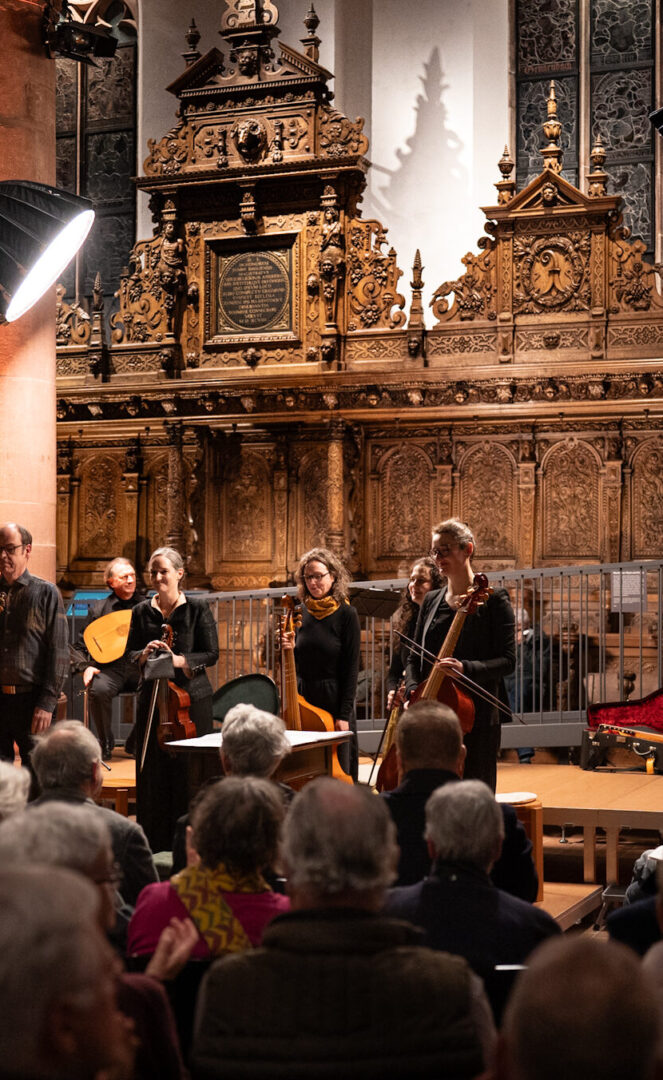
Barfüsserkirche, Historisches Museum Basel

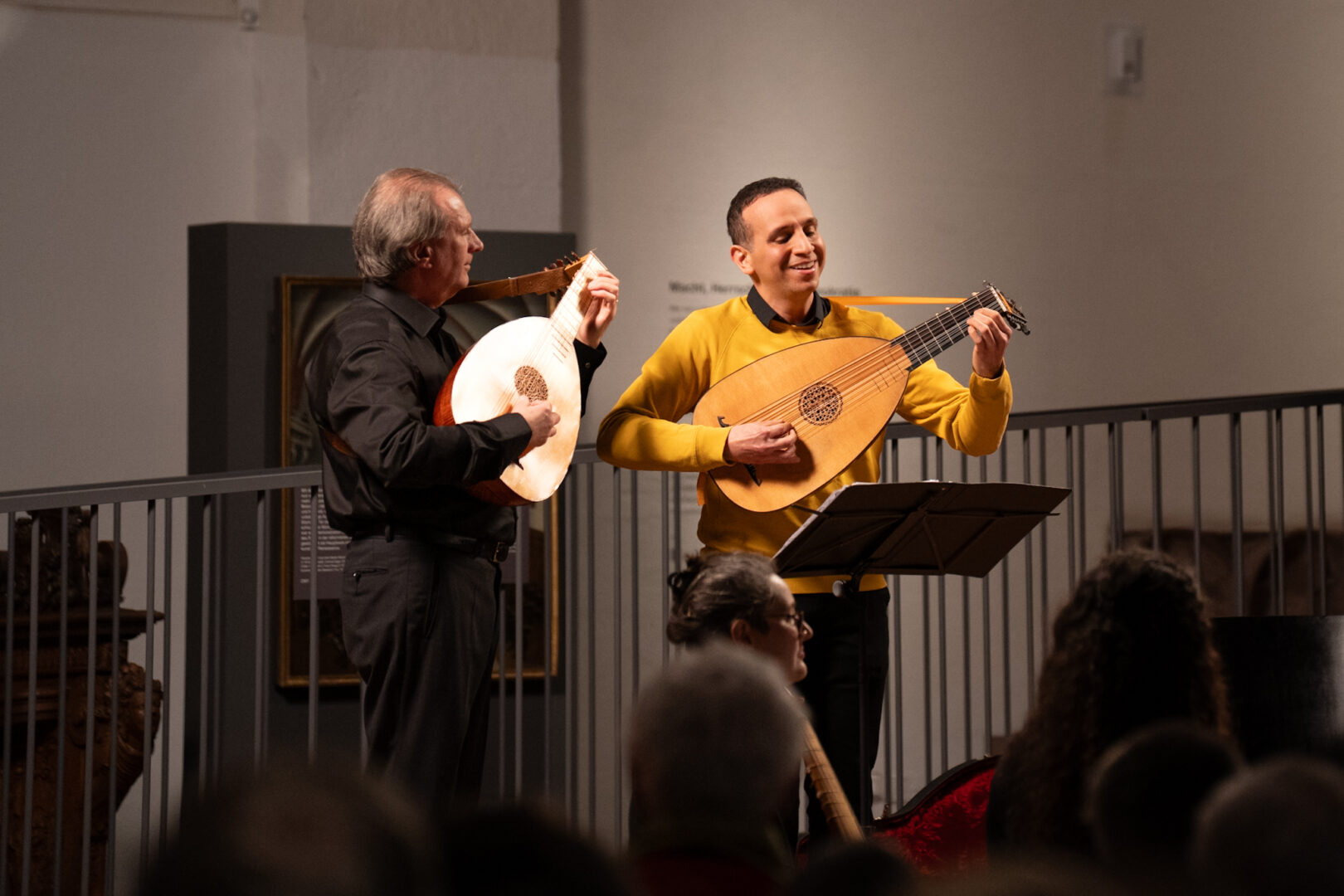
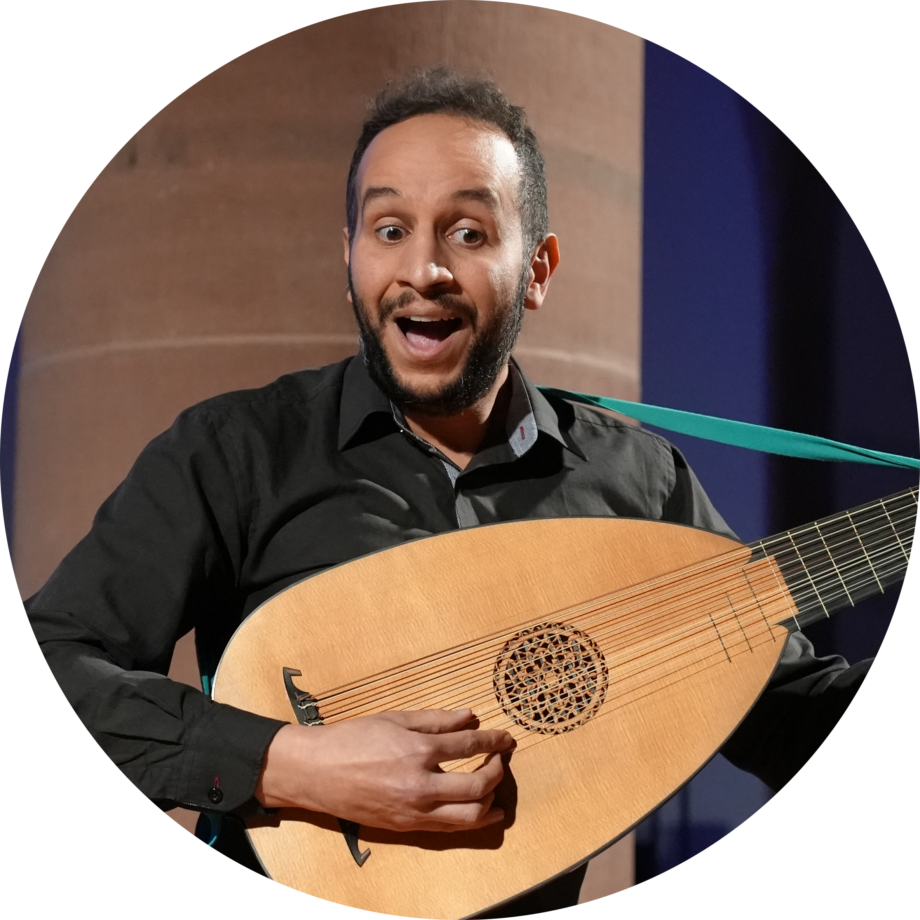
Foto: Maryam Javad

L

utes, voices, and viols: with these, John Dowland (c1563–1626) created a musical world unlike that of any other person in England of his time. Best known for his melancholic songs, Dowland’s solo lute works and consort pieces for viols are outstanding examples of their genre.

This program honours the 400th anniversary of Dowland’s death with a unique combination of lute songs and instrumental music that reflects the diversity of his musical practice.

Self-accompanied song, newly composed lute duos, and vocal and instrumental improvisations allow Dowland’s music to resonate in a rare way – one that captures the spirit of his era and brings his creative artistry back to life.

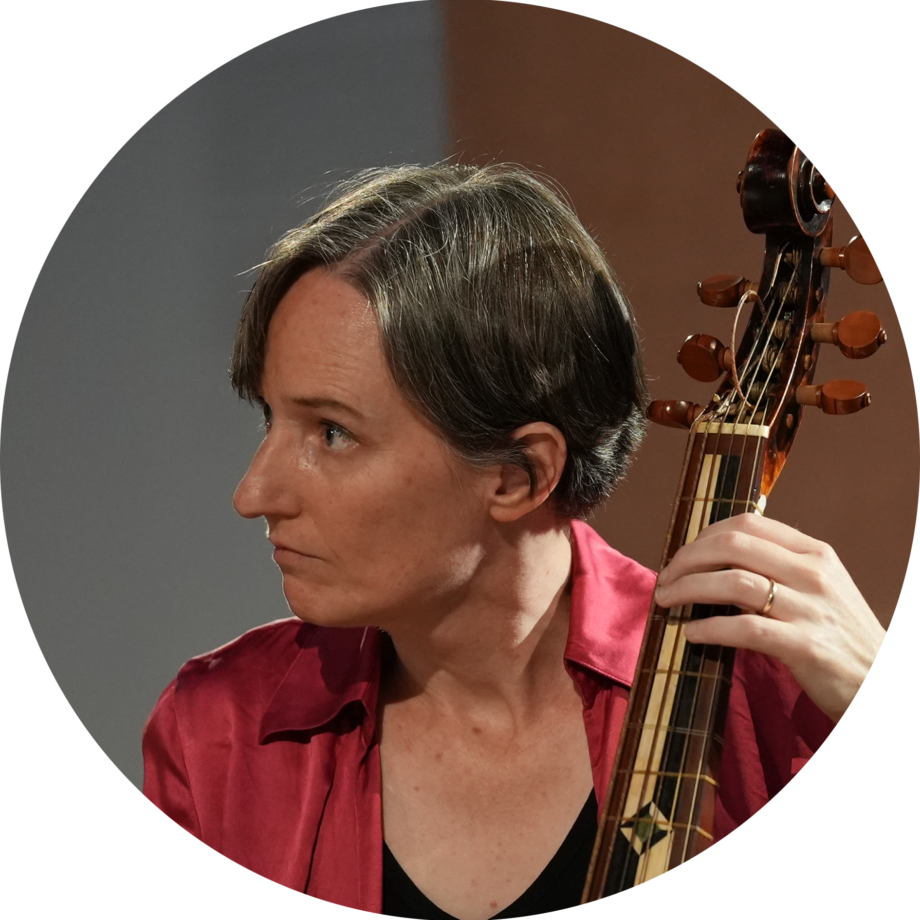
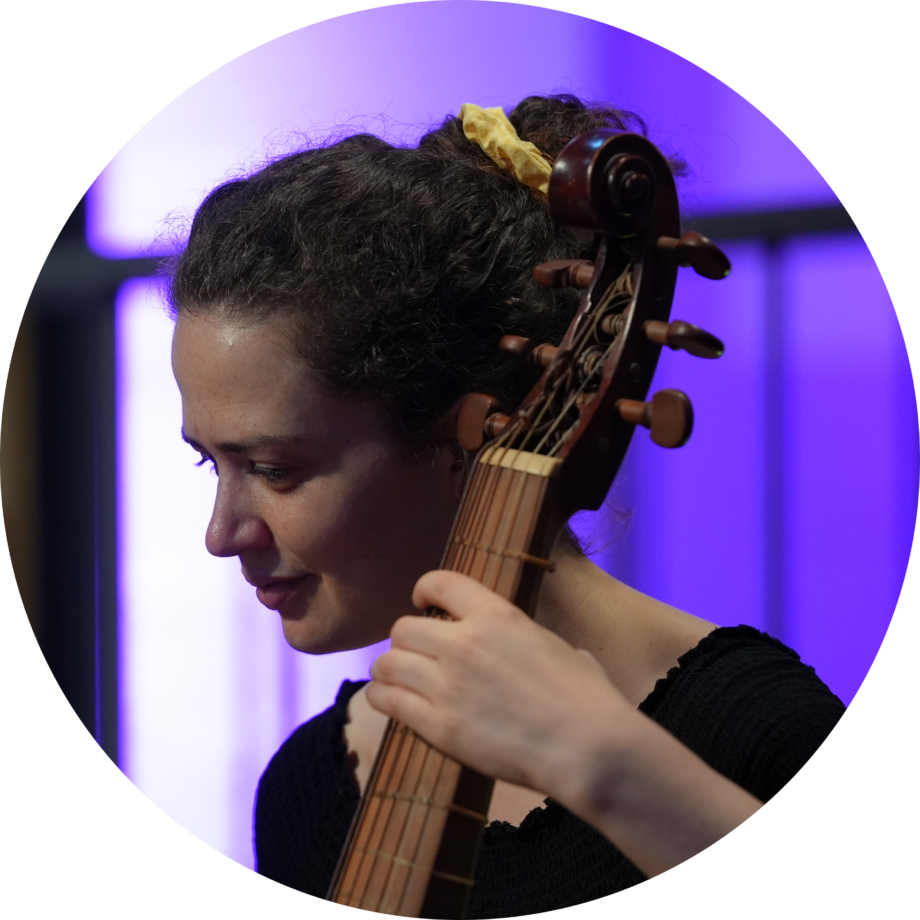
Giovanna Baviera – viol, voice
Brian Franklin – viol
Caroline Ritchie – viol
Elizabeth Rumsey – viol
Tabea Schwartz – viol
Peter Croton – viol
Ivo Haun – voice, lute; direction

Free entry (donations)

Foto: Maryam Javad

Interview

In honour of John Dowland, the “Master of Melancholy”, Dr. Thomas Christ speaks with Orí Harmelin – Lutenist and Gestalt therapist – about Renaissance music and the world of emotions.

TC: Dear Ori, by way of introduction my usual question about your career path: how does
one get from Haifa via Trossingen to Basel?

OH: Dear Thomas, Thank you for the invitation! It was the fascination with early music that first led me to
move to Trossingen, this strange little town in Swabia to study the lute under the tutelage of
Rolf Lislevand. When I first heard his album of music by Kapsberger (Libro Quarto d’Intavolatura di Chitarone: Roma 1640), I thought studying with him would remain a mere pipe dream, but before I knew it, I found myself in cold and snowy Baden Würtenberg. While I had always fantasised about studying under Hoppy as well, this was not to be, and so when I finally decided to move to Basel it was not to study in the Schola, but rather simply to crash the party, as it were. Eventually I studied under Eduardo Eguez in Zurich, but Basel always felt like home to me, so this is where I stayed.

TC: You specialized early on in the periods of Early Music, but later you also trained as a therapist, specifically as a Gestalt therapist. Can you tell us a bit about this bridge between the two?

OH: I discovered Gestalt therapy in a period when I felt stagnant in my musical development. Music had always been a passion for me, but at some point it became “just a job”. I was stuck in a comfort zone, and lost motivation. I subscribed to an inherited belief that as a musician “you have to practice X hours a day” and the more I thought I “should”, the stronger my inner “top dog” tried to force myself to practice, the more my inner “under dog” wined and rebelled, and the less and less I invested in the music. Allowing myself to follow my various interests though, I found a new passion in learning about philosophical anarchism, economics and psychology, all of which I did on my own at first. When I finally came across Gestalt, I felt that it resonated with my anarchistic interests since in its non dogmatic approach to therapy it trusts in the individual’s ability to self regulate, to live free and with self responsibility, and ultimately as Marshall Rosenberg put it “People who are in touch with their needs don’t make good slaves”. Moreover, while I was passionate about learning, I was spending so much time in my head, and my Gestalt therapy training that followed invited me to “Lose my mind and come to my senses” as Fritz Perls put it, that is, to begin and feel myself more rather than spend all my time shackled up in my own head. Interestingly it was through saying “yes” to Gestalt therapy (which I thought would also be a “no” to the music) that I regained my “yes” to the music, and got in touch with my passion for the lute again. It was after deciding to train in Gestalt that I finally recorded my first solo album “NESHIMA”.

TC: Music education, as well as professional musical performance, must by no means be marginalized as a form of social-therapeutic activity; rather, it is of great societal relevance for every community. In this context, I am interested in your thoughts on the significance of music and society, and on music as a universal language.

OH: I believe that the role music has to play as a therapeutic instrument cannot be overstated. But beyond that, music connects us with something primal just as dance does. In modern times, we are so far removed from our intuition. Our society is obsessed with the “rational”, with science, or rather scientism which is becoming our new god. Through this we may often lose touch with our gut feeling, our sense of divine creativity, and our bodily wisdom that knows what is nourishing and what is malignant to us. Music as well as dance, I believe are vital in reconnecting us to our core, to our instinct and to our intuition. I see music, perhaps more than any other art form, as an abstract language. As a result, the meaning-making process may differ extremely between composer, interpreter and listener. As listeners, the collection of notes we hear, we braid together in our ears, minds and hearts, influenced by the cultural and aesthetic contexts in which we are embedded. We make our own meaning out of the phenomenological array of notes, and put them together into a coherent whole, a full gestalt.

TC: On the topic of building bridges, your interest in crossover experiments has also energized your performance practice. How does fidelity to historical performance practice align with the enjoyment of so-called fusion concepts, where early Baroque meets elements of jazz?

OH: When I first discovered the world of early music I considered myself somewhat of a purist, I have long abandoned this position. The lute is simply the instrument that I know how to express myself through (as best I can) but I feel no extra fidelity to historical performance practice, I am simply greatly influenced by it. I have been touched and inspired by music by Cipriano da Rore as well as by John Coltrane, by Guillaume Dufay as well as by Leonard Cohen. We make music here and now, and so the bridges that I attempt to build are not about doing fusion for fusion’s sake, but as a natural result of a long-term musical process with an eclectic background.

TC: Baroque music has enjoyed enormous popularity in the media and in opera and concert houses over recent decades, while the music of the Renaissance and the Middle Ages tends to lead more of a niche, insider existence. Do you see a reversal of this trend?

OH: I don’t know that I am qualified to speak about trends in this field. I can only say that I enjoy the elegance of the renaissance more than the extravagance of the later baroque, and I am grateful to be living and working in a bubble that appreciates and celebrates that more intimate and perhaps even vulnerable type of music. While I see that it is less likely to attract big crowds, just as singer/song-writers are less likely to be as famous as the more flashy pop stars, I don’t have a problem with that, it’s not a zero-sum game, there is place for all kinds of music making, when we are all free to choose for ourselves what our likes and our dislikes are, what our passions are.

weiterlesen

Column

I’ll be there

by David Fallows

Dowland had it all. The five-voice pavans and dances in his Lachrimae show that he was an effortless master of counterpoint. His lute-songs give evidence that he was a poet at the very height of the best Elizabethan writers (we are not certain how many of the poems are his, but there are enough of them otherwise unknown for us to be able to put him absolutely on the top shelf). His lute music shows a combination of virtuosity and sheer direct communication to put him with the best and most communicative instrumental composers of his day. A concert entirely devoted to his music must be the best possible way of celebrating his life. Come along and enjoy.

Program

All pieces are compsosed by John Dowland (1563–1626).

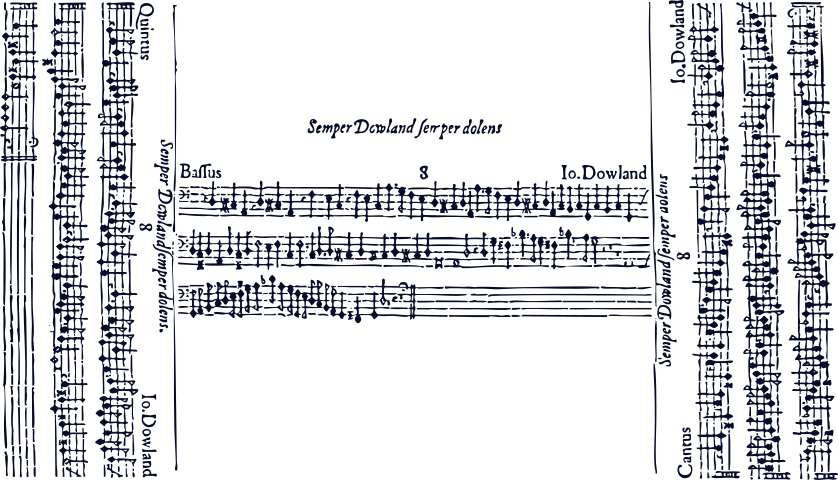
Semper Dowland semper dolens 

Lachrimæ, or Seaven Teares figured in Seaven passionate Pavans, with divers other Pavans, Galiards and Almands, set forth for the Lute, Viols, or Violons, in five parts, London: John Windet, 1604, Nr. 8  

2 Sleep, waiward thoughts 

The First Booke of Songes or Ayres of fowre partes with Tableture for the Lute: So made that all the partes together, or either of them seuerally may be song to the Lute, Orpherian, or Viol de gamboLondon: Peter Short, 1597, Nr.13 

____________  

3 Goe nightly cares, the enemy to rest 

4 From silent night, true register of moanes 

5 Lasso vita mia, mi fa morire 

A Pilgrimes Solace Wherein is contained Musicall Harmonie of 3. 4. and 5. parts, to be sung and plaid with the Lute and ViolsLondon: Gedruckt für M.L., J.B. und T.S. by the Assignment of William Barley, 1612, Nr.9–11 

____________ 

M. Iohn Langtons Pavan 

The King of Denmarks Galiard 

M. Buctons Galiard 

Mistresse Nichols Almand 

Lachrimæ, or Seaven Teares […], Nr. 10, 11, 19, 20 

____________ 

10 The Right Honourable the Lady Cliftons Spirit 

Varietie of Lute Lessons, London: Thomas Adams, 1610, fol. Nv–N2 

11 Lord WILLOUGHBY. OR, A true Relation of a Famous and Bloody Battel fought in Flanders, by the Noble / and valiant Lord VVilloughby, with 1500 English, against 40000 Spaniards, / where the English obtained a Notable Victory; for the glory and Renown of / our Nation. To the tune of, Lord Willoughby 

London: Printed for F. Coles, in Vine-Street, near Hatton-Garden, c1624–1680? (British Library – Roxburghe, C.20.f.9.62–63); Melodie nach «Rowland, or Lord Willoughby’s Welcome Home» – William Byrd (c1540–1623); Cambridge, Fitzwilliam Museum, Mus. Ms. 168 («Fitzwilliam Virginal Book»), Nr.160 

12 Lord Willoughby’s Welcome Home
London, Royal Academy of Music, MS 602 («Sampson Lute Book», c1610), fol. 11v; Washington, D.C., Folger Shakespeare Library, MS V.b.280 («Dowland Lute Book»), fol. 9v 

13 Can she excuse my wrongs with vertues cloake 

The First Booke of Songes […], Nr.5 

____________ 

14 Lachrimæ antiquæ novæ 

Lachrimæ, or Seaven Teares […], Nr. 2 

15 Flow my teares fall from your springs 

The Second Booke of Songs or Ayres of 2. 4. and 5. parts: With Tableture for the Lute or Orpherian, with the Violl de Gamba, London: Thomas Este 1600, Nr.2 

 16 Lachrimæ veræ 

Lachrimæ, or Seaven Teares […], Nr. 7 

17 Sir Iohn Souch his Galiard 

Lachrimæ, or Seaven Teares […], Nr. 13 

____________ 

18 My Lord Chamberlaine his Galliard 

The First Booke of Songes […], fol.L2v 

19 M. Henry Noel his Galiard  

20 Captain Digorie Piper his Galiard  

21 The Earle of Essex Galiard  

Lachrimæ, or Seaven Teares […], Nr. 14, 18, 12 

____________ 

 22 A fancy 

Cambridge, University Library, MS Add.3056 («Cosens lute book», c1610), fol.17v–18Cambridge, University Library, MS Dd.9.33 («Mathew Holmes lute book», c1600–1605), fol. 6v–7v 

 23 In this trembling shadow 

A Pilgrimes Solace […], Nr.12 


kursiv = instrumental 


2026

May

Fleuster une chanson

Song & Dance in Attaingnant's Prints
Sat 30.05.26 Sun 31.05.26 18:15 Concert

Sat Klosterkirche Dornach
Sun Barfüsserkirche Basel

June

Ach, wie grausam – A que vile

Songs for a mysterious lady
Sat 27.06.26 Su 28.06.2026 18:15 Concert

Sa Nydeggkirche, Bern
Su Barfüsserkirche, Historisches Museum Basel

September

Quodlibet

Puzzles, fun and games
Sat 26.09.26 Sun 27.09.26 18:15 Concert

Kirche Reigoldswil &
Barfüsserkirche Basel

October

The Queen’s Singers

The extravagant court chapel of the Tudors
Sun 25.10.26 18:15 Concert

Martinskirche
Basel

November

Byrd & the Baron

A secret Christmas
Sun 29.11.26 18:15 Concert

Barfüsserkirche
Historisches Museum Basel