Any fan of Renaissance vocal polyphony is likely to have heard of the composer William Byrd; and any fan of William Byrd is likely to see in their mind’s eye that notorious black and white portrait etching with the rather sharp beard, and to hear in their mind’s ear those Latin-texted compositions which have become the bread and butter of the modern choral tradition in England, sung a cappella in ethereal cathedral spaces by generously-attended robed choirs: Ave verum corpus, Ne irascaris Domine, the Mass for four voices, and numerous other favourites.
In reality, that earnest etched face to which we have become attached is not a true depiction of William Byrd—we have none—and the liturgical performance of his Latin-texted sacred works by cathedral choirs is not the setting the composer had in mind when he first wrote the Masses, the Gradualia, or the Cantiones Sacrae. What do we know of the ‘real’ Byrd, the private Byrd outside of his Chapel Royal achievements? After months of considering this programme, it seems fairer to ask: What do we know of William?
We know that William was a recusant. He remained Catholic and refused to attend Protestant church services under the English Reformation. On a professional level, this meant a delicate balancing act on his career path in the Chapel Royal under Protestant rule. On a personal level, it meant danger of prosecution, and the need for community: thick, familial, and if you were lucky, high-ranking community with an influence in case prosecution became a reality. Recusancy also meant that the uncontrollably expressive William, who had caused considerable trouble going off-piste in his organ improvisations while employed at Lincoln Cathedral, was expected to fetter his musical and religious zeal. Officially, he could write, sing, and play only that which was suitable for Protestant or Protestant-presenting ears, hearts, and printing houses. Despite his success, it was presumably a spiritually tiring way of life. William eventually took a step back from the Chapel Royal—without leaving it entirely—and moved to the Essex countryside. It was here that a middle-aged William found friendship and patronage in Baron John Petre, and the underground Catholic community which would nurture him into old age: musically, financially, spiritually, personally—and when necessary, secretly.
The main residences of the Baron, Thorndon Hall and the more private Ingatestone Hall, had all the trappings of a wealthy household, and particularly a Catholic one: John Petre had a chest of viols, a pair of virginals, an organ, at least one lute, and one or two ‘priest holes’ ready for hiding clergy in case his unlawful Catholic celebrations were disturbed at short notice. Regular music-making was a highlight of domestic life, and even Protestant households could enjoy relatively florid polyphony and Latin lyrics in a household setting as long as their minds remained pure; but in a Catholic household, the making of music together on religious feast days carried meaning for its participants which transcended entertainment. The Christmas season was particularly important for Catholic recusants, and it was in these kinds of musical settings—secret, risk-laden meetings under the roofs of influential Catholics such as John Petre—that William found his outlet as a skilled composer with an inconvenient personal calling to practice outlawed music.
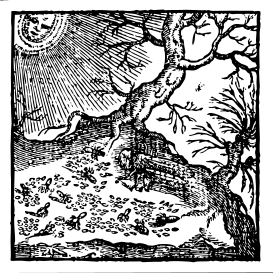
Most of the pieces performed this evening have been selected for their likelihood to have been enjoyed in the household of Baron John Petre, particularly around Christmas, and with his friend William present and taking part. Both William’s recusancy and his friendship with John Petre strengthened from the 1580s onwards, and as a result tonight’s programme is largely comprised of later compositions. William wrote several of these songs to be enjoyed in any musical household, by any convenient mix of professional or amateur singers, instrumentalists, men and women, regardless of their proclaimed or practiced religion. Included in this category are the three short offers of life advice by Geoffrey Whitney (In winter cold, Of flattring speach, and Who lookes may leape), as well as two of William’s instrumental arrangements of well-known tunes, Callino Casturame and Will yow walke the woods soe wylde. Other pieces have a more concrete connection to Christmas at John Petre’s: the Mass for three voices, something of a personal challenge and stylistic experiment for William in the 1590s, was an underground publication for secret usage by small groups of practising Catholics, such as those that the Baron hosted on important feast days. There are three pieces from 1589 publications on the list: the two English carols An earthly tree and From Virgin’s wombe, and the Latin-texted Ne irascaris Domine. These offer us a deliciously tangible glimpse into Christmas at the Baron’s that year; we know that William was at Ingatestone for the 1589 festivities, but so were the following characters: a group of string players hired from London, hot-off-the-press copies of the two new song collections, and another patron to whom one of those publications was dedicated. Several of the newly-printed pieces would already have been known to John Petre; Ne irascaris Domine appears in the sole surviving part book from his personal music collection, so we can be sure it was already a favourite in the household, and it was certainly a lyric close to oppressed Catholic hearts. There is little doubt that Christmas at Ingatestone Hall that year rang not only with music for a secret Catholic liturgy, but also with the music of the Songs of sundrie natures and the Cantiones sacrae. Tonight’s Pavan and Galliard also have a Petre connection: although originally written by William during his time at Lincoln, this pair was later re-worked and newly dedicated to John Petre’s son, William Petre. This may have been a commission from the Baron to celebrate the arrival of his new organ in 1590, wrapped in bed mats in an attempt to protect it from the uneven roads between London and Essex. It is another year we can be sure that William celebrated the Christmas season with the Petres, and presumably he couldn’t resist going off-piste on the new organ.
Lastly as far as tonight’s musical selection is concerned, a special mention will be made of the Gradualia, the publications from which Rorate caeli and Tu es Petrus stem. Quite blatantly musical embodiments of a Catholic practice, it is either a wonder or an attempt at entrapment that William’s two books of Gradualia were legally published. They represent something of the duality he was forced to adopt throughout his career, particularly in the years before he found his community in the Essex countryside. The Gradualia may look and sound like accessories to the Catholic liturgy, but they are legally not to be treated as such; they may be sung and played by any merry company of musicians at home, but should that company of musicians appear to be practising a Catholic mass, they risk prosecution. But which earthly authority could prove where William drew that spiritual line when he created and performed these works? William dedicated his second book of Gradualia to the Baron, seemingly in gratitude not only for his financial aid, but for the musical and spiritual refuge of the Baron’s household, which he credits with the cultivation of these personally significant compositions. It is with a piece from this book that we will close this evening’s concert. Tu es Petrus, with its glaring hint at the names of John Petre and the Catholic refuge of Ingatestone Hall (also called ‘Ginge Petre’ by the family), is a personal tribute from William to a supporter who provided a place of belonging when he felt unable to attend his own parish church.
You are Petrus, and upon this rock I will build my church.
Alleluia.