Crack the code hidden in Renaissance music! Long before escape rooms and crossword puzzles, composers such as Josquin des Prez and Jacques de Liège delighted in weaving secret messages, musical riddles, and ingenious challenges into their musical works. They constantly pushed one another to ever greater feats of creativity, inviting performers and listeners alike to solve their musical puzzles.
The title Quodlibet means “whatever one pleases”—a fitting tribute to the Renaissance spirit of invention, wit, and playful experimentation. This concert celebrates a world where music, intellect, and imagination come together in unexpected ways.
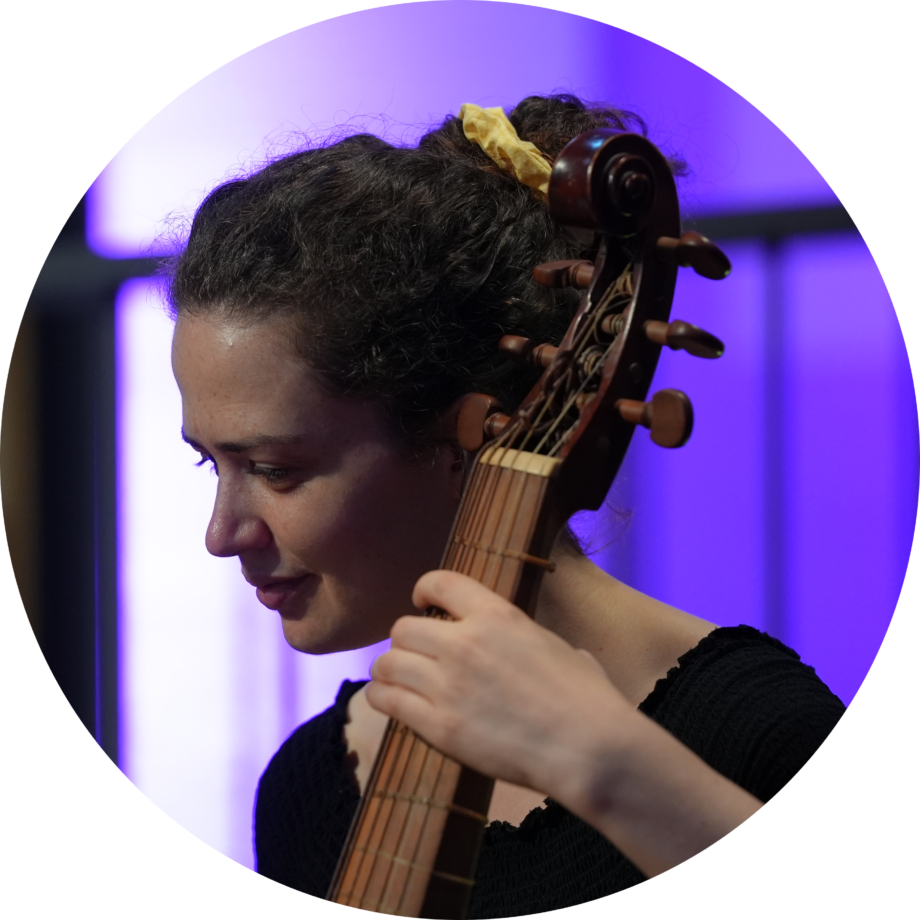
Grace Newcombe – voice, harp
Ivo Haun – voice
Tabea Schwartz – recorders, viola d’arco
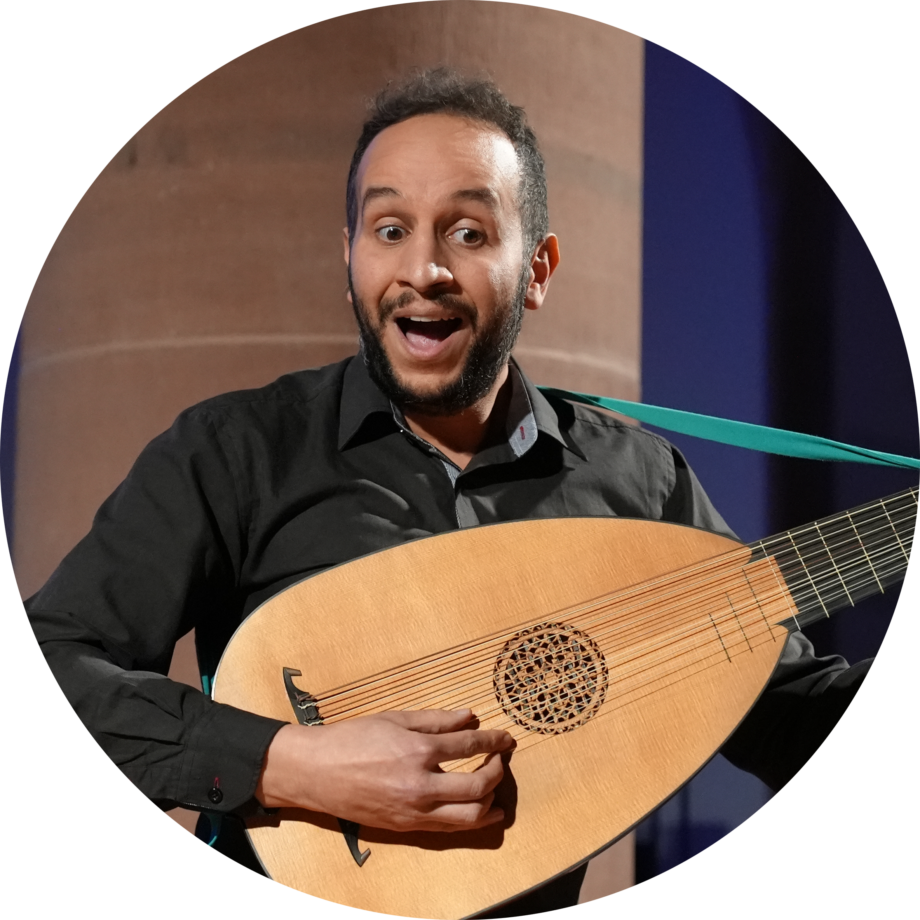
Marc Lewon – lute, viola d’arco, gittern, voice
Catherine Motuz – trombone, voice
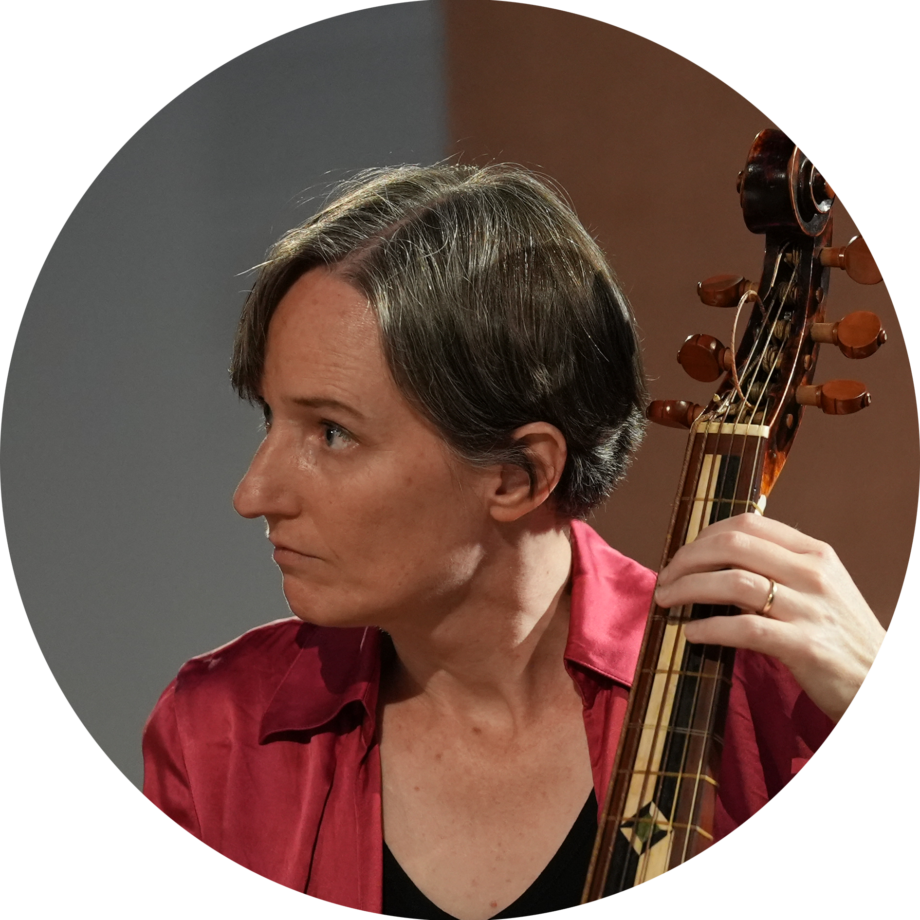
Elizabeth Rumsey – viola da gamba; direction
Free admission – collection
Saturday, 26 September 2026, 6:15 PM
Take part in a ReRenaissance hike in the Reigoldswil region before the concert.
For further information, please write to info@rerenaissance.ch
Kirche Reigoldswil, Chilchägerten 14, 4418 Reigoldswil
Sunday, 27 September 2026, 6:15 PM
Barfüsserkirche, Historical Museum Basel
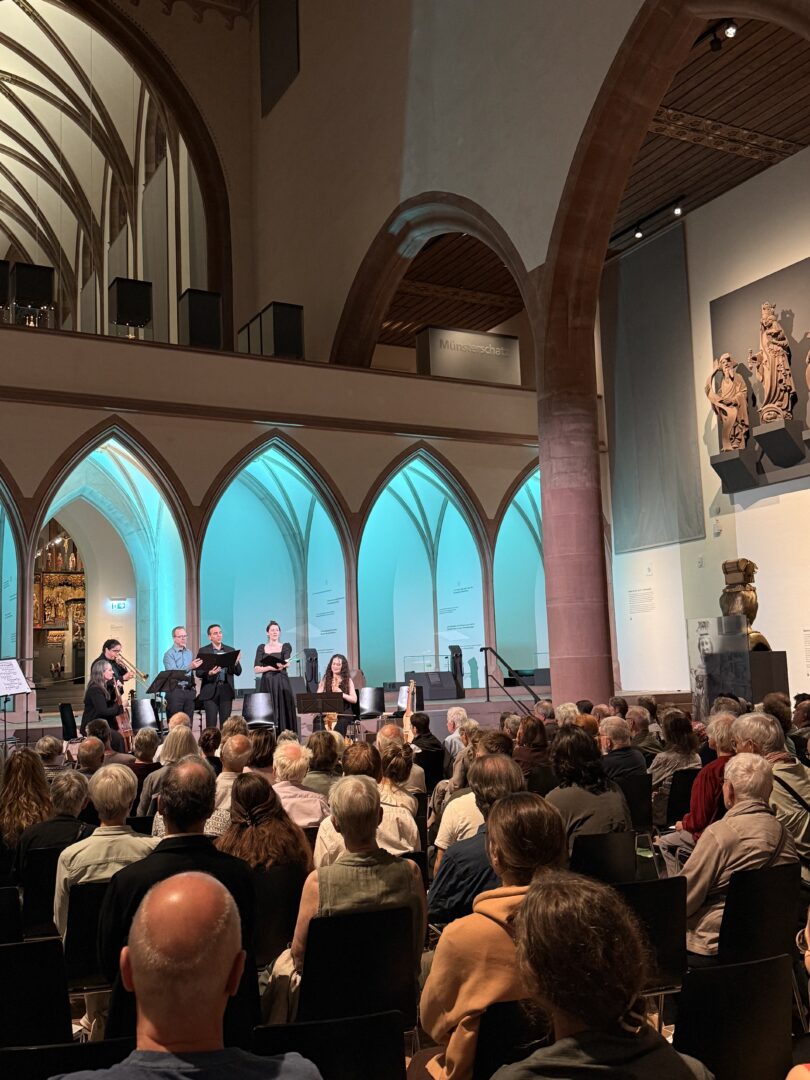
Renaissancemusik erklingt in der Barfüsserkirche Basel.
Kein Adler in der Welt so schön / Es taget vor dem Walde – Adrian Willaert (c1490–1562)
1. Salve sancta parens – Ludwig Senfl (c1486–c1543)
Liber selectarum cantionum quas vulgo mutetas appellant sex quinque et quatuor vocum, Augsburg: Grimm und Wirsung, 1520, fol. 272r
2. Illibata Dei virgo – Josquin Des Prez (c1450–1521)
Vatican City, Biblioteca Apostolica Vaticana, MS Capp. Sist. 15, fol. 246v–250r
3. In feuers hitz / O rosa bella – anonymus
Kraków, Biblioteka Jagiellonska, PL-Kj Berlin MS Mus. 40098
(«Glogauer Liederbuch»), Discantus: fol. F3v, Altus: fol. F10v, Tenor: fol. F7v–8r
4. Probitate eminentem / Ploditando exarare – Petrus Wilhelmi de Grudencz (1392–c1480)
Glogauer Liederbuch, Discantus: fol. E11v–12r, Altus: fol. F5v–6r, Tenor: fol. F1v–2r
5. Prenez sur moi – Johannes Ockeghem (c1410–1497)
Kopenhagen, Det Kongelige Bibliotek, MS Thott 291, 8° («Copenhagen-Chansonnier»), fol. 39v
6. De tous biens plaine – Alexander Agricola (c1445–1506)
Florenz, Conservatorio di Musica Luigi Cherubini, MS Basevi 2439, fol. 67v–68r
7. [La Spagna] Ottogesima Quinta – Costanzo Festa (c1485–1545)
Bologna, Civico Museo Bibliografico Musicale, MS C36
(«Bologna C36»), Nr. 85
8. Fortuna desperata – anonymus
Bologna, Museo Internazionale e Biblioteca della Musica, MS Q18, fol. 28v–29r
9. Que vous madame / In pace – Josquin Des Prez; Altus von
Alexander Agricola
Canti C, Venedig: Ottaviano Petrucci, 1503, fol. 104v–105r, Nr. 80
10. [La Spagna] Nonagesima Ottava – Costanzo Festa
Bologna C36, Nr. 98
11. De tous biens plaine – Hayne van Ghizeghem (c1445–1476/97) & Josquin des Prez
Harmonice Musices Odhecaton A, Venedig: Ottaviano Petrucci, 1501, fol. 102v–103, Nr. 95
12. The versions of «Ich stund an einem morgen» – Ludwig Senfl
i. Quodlibet with «Amica mea»
ii. «Bassus Discantum habet in decimis.»
Johannes Ott: Hundert und ainundzwanzig newe Lieder, von beruembtenn
dieser kunst gesetzt, lustig zu singen, und auff allerley Instrument
dienstlich, Nürnberg: Hieronymus Formschneyder, 1534. Nr. 24, 25
iii. Quodlibet with «Kein Adler in der Welt» and «Es taget vor dem Walde»
115 Weltliche u. einige geistliche Lieder, Nürnberg: Johannes Ott, 1544,
aus «Register der Liedlein mit Sechsen», Nr. 5
13. Mayntes femmes – Antoine Busnoys (c1430–1492)
Canti C, fol. 117v–118r, Nr. 92
14. Two canons over a known song by Claudin de Sermisy
(c1490–1562)
i. Languir me fais – anonym
Hermann Finck: Practica musica, exempla variorum signorum,
proportionum, et canonum, judicium de tonis ac quaedam de arte
suaviter et artificiose cantandi continens, Wittenberg: Georg Rhau,
1556. S. Nni-v–Nnii-r
ii. Languir me fais – Josquin Baston (tätig 1542–1563)
Vingt et six chansons musicales & nouvelles a cincq parties conve-
nables tant a la voix comme aussi propices a jouer de divers instru-
ments, Antwerpen: Tielman Susato, c1543, Nr. 22.
15. Kein Adler in der Welt so schön / Es taget vor dem Walde – Adrian Willaert (c1490–1562)
Five drawings with musical notation: anonymus, Southern-Germany, c1550, Friedrich-Alexander-Universität Erlangen-Nürnberg, Graphische Sammlung
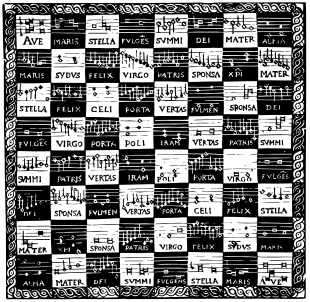
16. Ave maris stella – Ghiselin Danckerts (1510–1567) / Pietro Cerone (1566–1625)
El melopeo y maestro: tractado de música theorica y pratica, Libro veyntidoseno, Neapel: Giovanni Battista Gargano & Lucrecio Nucci, 1613, S. 1129
17. Hastu mir die laute bracht / O rosa bella – anonymus / John Dunstaple
Glogauer Liederbuch, Discantus: fol. F3v, Altus: fol. F9v, Tenor: fol. F5v
18. Ave Maria – Josquin des Prez / 5. and 6. voice: anonymus
München, Bayerische Staatsbibliothek, Mus. MS 41, fol. 226v–238r
by Uri Smilansky and Katharine Hawnt
Consider yourself warned: some of tonight’s music is deceptive, intentionally hiding its most interesting characteristics. Some of it was intended primarily to be seen, some to be heard and some to be analysed at one’s leisure. Occasionally, performing it in the wrong time and place could even be dangerous!
Puzzles, games and hidden meanings appear throughout music history, with changes of fashion affecting their prevalence and character. Today’s selection represents a particularly rich period, where setting challenges and going beyond normal practice was an important calling card of composers, performers, patrons and book-owners attempting to separate themselves from the crowd. These puzzles fall into a handful of recognisable types. Some games are designed to be noticed and only work in performance. The «clockwork» rhythmic patterns of Agricola’s De tous biens plaine and the anonymous Fortuna desperata, for example, are noticeable to the ear, showcasing the technical virtuosity of their composers, and by implication, their performers. Josquin’s De tous biens plaine takes this a step further. Its canon moves at the interval of a single minim — the shortest possible gap between voices — creating the effect of a breathless footrace, one voice chasing hard on the heels of the other. This is no accident: the canon is captioned with a Latin tag alluding to John 20:3–4, in which Peter and John race each other to Christ’s empty tomb on Easter morning. The effect challenges not only the performers, who must keep pace with one another, but the listener too, who must follow the chase by ear.
Two further puzzle elements concern how the piece appears on the page. The first lies in the notation itself: one voice is not written down, with two performers reading the canon from the same notes. The second lies in how little Josquin explains this: rather than spelling out instructions, he sticks to the biblical reference. Both devices, however, only work if you can see the page yourself — hardly a given, in a culture where written music remained expensive and exclusive, and where professional performance was still largely done from memory.
As settings of famous songs, all these pieces offer an audible juxtaposition between the old and the new, the familiar and the novel. This is also the case in the reworkings of Josquin’s Que vous ma dame and Ave Maria, where, rather than a famous melody, entire settings were taken and «extra space» found for additional voices to go with them.
Most audible and game-like, however, are the quodlibets from the Glogauer Liederbuch. These compositions all take the famous O rosa bella melody and add two new voices to it: one freely composed, the other consisting entirely of snippets of other known songs, sewn together to fit the pre-given material. What emerges goes beyond a game of compositional skill. Each snippet challenges the listener to identify its origins, and with this recognition comes a web of allusions to external contexts, meanings, settings, and sound worlds.
The two examples played today, though, do not work in the same way. As Marc Lewon has shown, the Hastu mir die laute bracht quodlibet aims for a comic, self-aware, self-referential effect. It offers extreme thematic and linguistic juxtapositions, often referencing musical instruments and performance, and emphasises the disjointed character of the quotation game as it interrupts the long, flowing melody of O rosa bella. Listening to In feuers hitz in the same way, however, would miss the point. Here, despite using exactly the same compositional technique, the game is to transcend the multiple points of origin of the new text, weaving them together into a new, unified, expressive love song. To appreciate it, one has to resist being distracted by recognising each segment individually. Without any visual differentiation, this voice functions as one would expect from a love-poem, while the quilted voice of the other quodlibet does not. One must recognise this analytically during performance, not by looking at the manuscript.
Other pieces in today’s programme take the opposite extreme, aiming at maximum visuality. As is often the case with visual pieces, listening alone tells you very little. Sonically, they are often unremarkable, hiding their ingenuity behind a plain surface. Senfl’s Salve sancta parens, for example, sounds like a simple piece in which all voices harmonise a single text together. Looking at it, however, is a completely different experience. Rather than notating four separate vocal lines, Senfl presents a single six-by-six grid of thirty-six bars, each containing a pair of notes and a two-syllable word, alongside the Latin instruction «Notate verba, et signate mysteria» — «Note the words, and observe the mysteries.» Each pair of singers begins at opposite corners of the square, with each voice moving in a different direction along its sides, working its way towards the centre following the logic of the Marian text. Scholars still do not fully agree on its solution: at least five different readings have been proposed since 1829, the latest as recently as 2010. Likely dedicated to the Salzburg Archbishop Matthäus Lang von Wellenburg, the piece seems designed to impress its patron as an object to be studied, rather than a piece to be heard — performing its purpose most fully, perhaps, in silence.
Ghiselin Danckerts was clearly impressed by this model, building his own puzzle canon along similar lines — while making sure he outdid his predecessor. His Ave Maris Stella is presented as a chessboard of 64 squares, adding a further layer of visual playfulness and challenge. Like Josquin and Senfl, his instructions are as enigmatic as they are unhelpful. The piece bears nothing more than an indication that it is for four voices, and the motto «Quod appositum est et apponetur per verbum Dei benedicetur» — «What is, and will be, placed together, will be blessed by God.» Only through a separate treatise of his do we know that the grid offers more than twenty viable polyphonic solutions, each yielding a short motet in its own right. No wonder the piece was already considered difficult in its own time: when Pietro Cerone reprinted it in 1613, he admitted that he could not fully resolve it himself.
There is a third kind of puzzle, neither easily seen nor heard: the acrostic, in which a composer’s or dedicatee’s name is hidden within a piece’s text, spelled out by combining the first letters or syllables of each word, line, or strophe. Nowadays, we are more accustomed to simple, line-based acrostics, and these can seem barely concealed, used as we are to texts and translations laid out according to poetic lineation. This, however, was not necessarily the case in original copies, especially not for texts set to music. Here, one must fish for letters scattered haphazardly across the page, sometimes at unusual distances from one another. This can be done, but it requires poring over the page for extended periods. Recognising an acrostic by ear alone, without the page in front of you, is harder still, especially when it is stretched out over long distances: it demands real memory and mental agility, particularly if the actual text — or sometimes multiple texts — of the piece must also be followed at the same time.
Willaert’s dedication of Kein Adler in der Welt / Es taget vor dem Walde to Katharina Adler combines one such stretched-out acrostic with a pun on her surname. As this was likely a wedding piece, it seems reasonable to assume the dedication was meant to be noticed and worked out. Who was supposed to notice Josquin’s self-reference in Illibata Dei virgo nutrix, and when, is less clear. Here, a second puzzle element leads away from identification rather than towards it: a simple, repeating three-note figure — sung to the solmisation syllables la-mi-la — runs through the piece, gesturing toward the Virgin’s Latin name, Maria, without ever quite spelling it out in notes.
Perhaps the true master of the acrostic, however, was Petrus Wilhelmi de Grudencz. All his known compositions include some kind of acrostic encoding his name — indeed, that is how we know many of them must be by him. Indexing his works is, therefore, a thankless task, since all of them begin with a «P.» Probitate eminentem / Ploditando exarare, however, offers a different kind of dichotomy between page and sound. Its better-preserved copy contains two laudatory texts praising the monk Andreas Ritter and two untexted voices. So far, so functional, as a dedicatory piece designed to obtain or celebrate patronage. As Paweł Gancarczyk has shown, however, the musical setting alternates the two texts in such a way as to invert their meaning entirely, demeaning the dedicatee as an impious drunkard rather than praising him. Was it given to Ritter on the assumption that he lacked the musicality to notice, or that he would only ever read the text and never hear it sung? Was it passed among his colleagues to snigger at behind his back, ready to feign innocence if caught? A second, fragmentary copy of this motet survives, which used to include the name of a different dedicatee, now rubbed out beyond recognition. Does this erased name suggest a later owner tried to reuse the piece for someone else, only to realise its built-in irony too late — or that a piece once useful precisely because it was subversive became too dangerous to perform once its secret was out?
All these questions bring us back to the basic difficulty with riddles. Who are they for, and what interest do they hold once solved? Do they operate more as sound or as object? Do they attract attention to the notation, the performer, the composer, or the patron? Are they occasion-specific, or do they travel well across space and time? As with all cultural artefacts, the answer usually lies in some sort of grey zone. Thus, each puzzle in tonight’s programme creates its own small web of concealment and exposure — probing who gets to be in on the joke, and who is left outside it, each imagining themselves rather pleased with their place. Tonight, that includes you: as you listen, decide for yourself whether you are the intended audience for these centuries-old jokes, or simply eavesdropping on someone else’s.
Barfüsserkirche
Historisches Museum Basel
Dorfkirche Riehen

Barfüsserkirche
Historisches Museum Basel
3 Kleinkonzerte
St.-Alban Quartier, Basel